




Can the Rockies Break Free from Tradition and Revolutionize Their Future in MLB?
High above the Rockies’ hometown, a fresh dawn peeks timidly over Coors Field—well, at least the shadows of an old, dismal era are slipping away. For the fans in Denver, this isn’t just welcome—it’s downright necessary. Let’s be honest: The Colorado Rockies have, for years now, been the poster children for baseball misery. Since 2020, no team in MLB has stumbled their way through more losses, and Colorado stands alone with a winning percentage failing to crack .400 in that stretch. Playoff dreams? They’ve been out of reach since 2018, and under Dick Monfort’s watchful ownership since 2011, postseason victories have been nearly mythical—just one to their name.
It may come as a shock that the nadir was still yet to arrive. The 2025 Rockies campaign was a bona fide train wreck—starting with a dismal 9-50 plunge and limping toward a 43-119 finish, barely dodging the all-time loss record by a whisker. Their pitching staff surrendered more runs than any other team—1,021 to be exact—while the offense languished near the bottom at 29th in runs scored. That ghastly minus-424 run differential? The worst the modern game has ever witnessed.
But here’s the twist in this grim tale: Sometimes, rock bottom is exactly what an organization needs to shake off the rust and reopen its eyes to innovation. Bud Black was the first to exit when the doors finally swung open in May, followed by GM Bill Schmidt and assistant GM Zack Rosenthal as the season drew its ugly close. A seismic front office shakeup ensued, culminating in the hiring of Paul DePodesta—yes, the very architect behind the “Moneyball” revolution—as the new president of baseball operations, alongside Josh Byrnes, a seasoned GM with a keen eye on drafts. Add to that Warren Schaeffer’s promotion to full-time manager, and you’ve got a breeze of fresh air against the stale backdrop of years of stagnation.
Invoking DePodesta is no small matter; the very man who sparked a statistical revolution in baseball is now steering this floundering ship. Walker Monfort, the voice of a new generation within the franchise, didn’t mince words about their past shortcomings. They “probably lost sight of innovation,” he confessed, acknowledging a half-decade lost to inertia. It’s a candid admission, but it reveals hope—a chance to pivot aggressively, reimagine player development, rethink pitching strategies tailored to Coors Field’s altitude peculiarities, and, simply put, to start winning more ballgames.
The path ahead is daunting, no doubt. How many of the veterans entrenched in decades of Rockies culture will embrace this new dawn? Will Dick Monfort greenlight a complete rebuild or opt for a more cautious overhaul? The stakes have never been higher. But at last, the Rockies have cracked open the door to change. The mountain to climb remains imposing, the trail steep—but at least now, they’re moving upward.
A mile high, a new day is dawning over Coors Field. Or at the very least, an old day is fading to black.
To the ball fans of Denver, that is welcome news.
For a long while now, the Colorado Rockies have been an utter catastrophe, the epitome of sporting woe. Since 2020, no MLB franchise has lost more games. Colorado is the only club with a winning percentage south of .400 over that span. The Rockies have not reached the postseason since 2018 and have captured just one postseason victory since current owner Dick Monfort became the team’s control person in 2011.
Advertisement
Yet somehow, rock-bottom only just arrived.
The 2025 Rockies were a disaster, an eyesore, an undermanned, poorly constructed excuse of a big-league team. After starting the season 9-50, Colorado managed to climb its way out of the record books, if only by a hair. The Rockies finished the campaign 43-119, two losses shy of the all-time mark. The pitching staff led baseball in runs allowed (1,021), and the lineup finished 29th in runs scored (583). That minus-424 run differential was the single worst mark of the modern era.
All that losing had one silver lining: Change, something the entire organization had long seemed allergic to, is finally happening.
‘We’ve probably lost sight of innovation’
First out the door was longtime manager Bud Black, fired in May amid the team’s catastrophic start. Then, at the season’s merciful end, came the departure of two organizational fixtures: general manager Bill Schmidt and assistant general manager Zack Rosenthal. Schmidt joined the Rockies in 1999 and had been GM since 2021. Rosenthal was hired in 2006 and rose to AGM in 2014. Publicly, neither was fired, as Rosenthal resigned and the Rockies framed Schmidt’s leaving as a parting of ways, but their exits were a direct result of the team’s horrendous season.
Advertisement
In November, after a lengthy, disjointed search, the Rockies hired former “Moneyball” darling Paul DePodesta to be the club’s new president of baseball operations. DePodesta, 52, rose to fame as a key figure in the early days of baseball’s statistical revolution, but he spent the past decade as the chief strategy officer for the NFL’s Cleveland Browns. To work beneath DePodesta as the general manager, Colorado brought in Josh Byrnes, a front-office vet with GM stints in San Diego and Arizona. Byrnes, 55, had been the Dodgers’ senior vice president of baseball operations since 2014, with a focus on the MLB Draft. Finally, the team announced that Warren Schaeffer, who finished the season as the interim manager, would be back in 2026.
DePodesta’s hire was surprising, especially given that the Rockies were reportedly deep into talks with Cleveland’s Matt Forman and Arizona’s Amiel Sawdaye, two well-regarded executives with real influence in their respective organizations. But the man who inspired Jonah Hill’s character in “Moneyball” is, at the very least, an outside voice, something that couldn’t be said about Colorado’s previous two top baseball ops execs.
The task ahead of DePodesta, Byrnes and whoever else heeds the call is downright monumental. This is an organization in disarray, depressingly behind the times. Walker Monfort, the owner’s older son and the team’s executive vice president, has been refreshingly open about that in the weeks since DePodesta’s hiring.
“I think one thing that I would attribute to the past, you know, half-decade that we’ve been through,” Walker, 39, told DNVR Rockies this week, “we’ve probably lost sight of innovation and lost sight of just continuing to evolve our process.”
‘Everybody seems to be a lifer’
While it’s encouraging that Monfort, who holds significant sway in the franchise and was a key part of the executive search, understands the situation, it’s a massive problem that things went so sideways in the first place.
Advertisement
How did it get this bad?
A dozen former Rockies players, employees, coaches and other industry voices described a baseball operations department sealed off from the modern game. While most praised Monfort for his loyalty and described him as an affable character, they claimed that loyalty also precluded the Rockies from adopting new ideas, calcifying the entire operation from within. Over the past half-decade, as the rest of the league modernized at warp-speed, Colorado’s ambivalence toward innovation left it mired in the dark ages and unable to deal with the unique challenges of playing at high altitude. That fans continued to pack Coors Field, despite the on-field ineptitude, reduced any incentive for the team to rethink its approach.
“The entire operating model was do what we tell you to do, be loyal,” one former employee told Yahoo Sports. “And we don’t even care if you’re competent. We just want to keep things exactly as they are.”
Indeed, before this winter’s drastic overhaul, Colorado’s front office featured a stunning amount of continuity. Among the nine people who held director-level positions or above in Colorado’s baseball operations department entering 2025 (including the since departed duo of Schmidt and Rosenthal), the average tenure was a whopping 26 years.
Advertisement
Danny Montgomery (VP/AGM of scouting), Rolando Fernandez (VP of international scouting), Paul Egins (senior director of MLB operations) and Marc Gustafson (senior director of scouting) have all been employed by the Rockies for more than 30 years. Both Chris Forbes (senior director of player development) and Brian Jones (director of R&D) have eclipsed the 20-year mark. In fact, the only person director-level or higher with fewer than 20 years of Rox Time is Sterling Monfort, the director of pro scouting and the owner’s youngest son.
“Everybody seems to be a lifer. It is kind of insane,” a former Rockies minor leaguer explained. “A lot of coaches were former players. Some people I played with, you know, they’re great guys, but I never thought, ‘Wow, this guy should definitely be a professional baseball coach.’ And all of a sudden, they’re the hitting coach somewhere the next year.”
[Get more Colorado news: Rockies team feed]
Certainly, a number of the Rockies’ loyalists are intelligent, employable baseball people with worthwhile perspectives and valuable experience. But the absence of outside voices, fresh ideas or modern insights effectively fossilized the entire baseball operations department from the top down. That insular environment created what other teams consider to be a very warped view of contemporary baseball, something that rears its head quite often in trade negotiations.
Advertisement
“Every trade deadline is mind-boggling to the point it’s expected we won’t get a reasonable or usable response,” a member of another club’s front office told Yahoo Sports. “We understand that if there’s a targetable player on Colorado, we’re probably not going to acquire him because [the team’s] logic is singular.”
‘There’s not really an incentive to win’
The team’s resistance to evolution has been particularly harmful as it pertains to pitching development — or lack thereof. Multiple former Rockies hurlers admitted they actively sought help from sources outside the organization after realizing that their club’s pitching coaches and staff were unable to help them improve. That arms such as Jeff Hoffman, Jon Gray and Tyler Matzek experienced success upon leaving the Rockies only furthered the belief among pitchers inside the org that something was seriously wrong.
Advertisement
“They did nothing but waste five years of that guy’s life,” one former Rockie said of Hoffman’s time in Colorado.
Others described an atmosphere outright opposed to modern technologies that have become commonplace around professional baseball. Two separate sources recounted a story from the beginning of the 2024 season, when the team prohibited players at multiple levels from throwing bullpens in front of trackman units, mobile devices that capture and display pitch data in real time.
“I remember somebody more or less tricked an intern into giving us a TruMedia password,” a former Rockies minor-league player recounted, referencing the data analytics platform used by a majority of MLB clubs. “And it was just, like, one TruMedia password spread across a pretty good chunk of the org’s players so that they could see game data.”
One prominent agent told Yahoo Sports that due to the Rockies’ poor reputation for development, their agency has had higher draft signing-bonus demands for pitchers garnering interest from the team. A pitcher from another organization described a former Rockie as being on “cloud nine” upon learning about his new team’s technological capabilities.
Advertisement
Colorado does employ a handful of progressive pitching types — names mentioned include coordinator of performance science Emilio Martinez and former big leaguer Scott Oberg, who serves as the team’s director of pitching — but forward-thinkers of that ilk have been few and far between, and they’ve rarely received the institutional buy-in to implement new ideas.

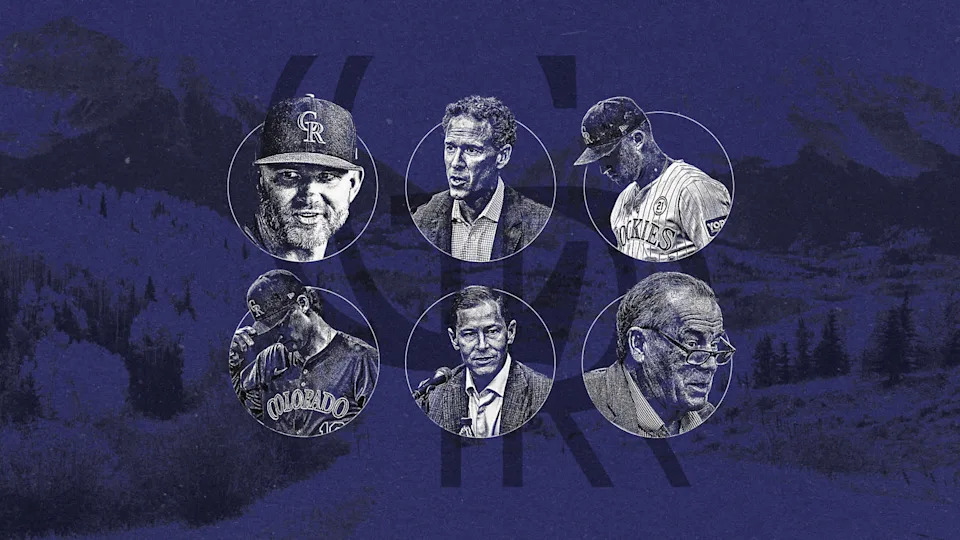
With Paul DePodesta (top middle) now in charge, there’s reason for optimism that a renovation of Colorado’s front office is coming.
(Amy Monks/Yahoo Sports)
’A beer garden with a ball field’
Colorado’s organizational stasis was further reinforced by the team’s sustained success on the business side. Why change the process when you’re making money?
Coors Field is a gem of a ballpark, and the Rockies pack it more often than you’d expect for a divisional doormat. The team has finished in the top half of the league in attendance per game every season since 2008 and did so again in 2025, despite the abysmal on-field performance. One former player jokingly described the yard as “a beer garden with a ball field.”
Advertisement
A different departed employee, in a round-about way, framed the dynamic as a compliment. “They’ve diversified the business in a way that I think is actually shrewd,” he said. “There’s not really an incentive to win. Then the baseball part just becomes this old guys’ fantasy team, basically.”
Another former Rockie was much more critical, telling Yahoo Sports during the 2025 season: “As long as the bottom line is good, [Monfort] doesn’t give a s***.”
But that same player was extremely complimentary of Monfort as a person and the general friendliness that pervaded all parts of the operation.
“Dick Monfort is an incredible person to be around,” the former player said. “Everybody was great, and they all treated me well. They were all super nice, caring people, but it’s because they’re so comfortable at their job — because they know performance does not matter.”
Advertisement
More MLB news


With the hiring of DePodesta, that dynamic has already begun to change.
All signs point toward a renovation of Colorado’s front office, with player development first up. During his introductory news conference, DePodesta made a special mention of rethinking how the Rockies approach pitching. Byrnes, who ran point on the Dodgers’ draft for years, will surely modernize the team’s amateur scouting department. Figuring out how to turn the high-altitude mysteries of Coors Field into a home-field advantage will also be absolutely crucial.
But at this point, it remains to be seen how many of the multi-decade, high-level employees stick around for the DePodesta Era. That hinges on whether Dick Monfort gives the green light for a total teardown. Assuming he does, the tough part will begin in earnest, as DePodesta and Byrnes will have to identify qualified candidates and sell them on a new vision for Colorado baseball — and then, eventually, craft a competitive roster.
Advertisement
But while the mountain is tall and the path to the summit arduous, the Rockies have already taken the most important step: Trying something new.
CHECK OUT THE HOTTEST DEALS ON AMAZON!

High Cheese Baseball Walk Off Mystery Pack - 2 Cards, 1 PSA Graded & 1 Autograph/Relic Ungraded
$39.99 (as of January 21, 2026 14:55 GMT +00:00 - More infoProduct prices and availability are accurate as of the date/time indicated and are subject to change. Any price and availability information displayed on [relevant Amazon Site(s), as applicable] at the time of purchase will apply to the purchase of this product.)
Topps 2023 Series 2 Baseball Factory Sealed Retail Value Box - Baseball Wax Packs
$29.99 (as of January 21, 2026 14:55 GMT +00:00 - More infoProduct prices and availability are accurate as of the date/time indicated and are subject to change. Any price and availability information displayed on [relevant Amazon Site(s), as applicable] at the time of purchase will apply to the purchase of this product.)
2025 Panini Mosaic Football Trading Cards Hanger Box
$38.00 (as of January 22, 2026 14:55 GMT +00:00 - More infoProduct prices and availability are accurate as of the date/time indicated and are subject to change. Any price and availability information displayed on [relevant Amazon Site(s), as applicable] at the time of purchase will apply to the purchase of this product.)
2025 Bowman U Now Fernando Mendoza #60 -Hoosiers Named 2025 -Heisman Trophy Winner - Football NCAA- Indiana Card Shipped in Protective Screwdown Holder.
$21.95 (as of January 22, 2026 14:55 GMT +00:00 - More infoProduct prices and availability are accurate as of the date/time indicated and are subject to change. Any price and availability information displayed on [relevant Amazon Site(s), as applicable] at the time of purchase will apply to the purchase of this product.)
2025 Panini Mosaic Football Trading Cards Mega Box
$59.87 (as of January 21, 2026 14:55 GMT +00:00 - More infoProduct prices and availability are accurate as of the date/time indicated and are subject to change. Any price and availability information displayed on [relevant Amazon Site(s), as applicable] at the time of purchase will apply to the purchase of this product.)
Fernando Mendoza 2025 Bowman University Now #45 Hoosier Record Rookie Card PGI 10
$49.99 (as of January 22, 2026 14:55 GMT +00:00 - More infoProduct prices and availability are accurate as of the date/time indicated and are subject to change. Any price and availability information displayed on [relevant Amazon Site(s), as applicable] at the time of purchase will apply to the purchase of this product.)
NEW 2025 ABSOLUTE Football Card HUGE Retail Box with 192 Cards, Chance for Ultra Rare KABOOM Inserts!
$149.99 (as of January 22, 2026 14:55 GMT +00:00 - More infoProduct prices and availability are accurate as of the date/time indicated and are subject to change. Any price and availability information displayed on [relevant Amazon Site(s), as applicable] at the time of purchase will apply to the purchase of this product.)
2025 2026 Upper Deck Series One Hockey Unopened Blaster Box of Packs with a Young Guns Rookie Card, an OPC Glossy Card, an Encore Insert and Green Dazzler Card Plus
$28.99 (as of January 21, 2026 14:55 GMT +00:00 - More infoProduct prices and availability are accurate as of the date/time indicated and are subject to change. Any price and availability information displayed on [relevant Amazon Site(s), as applicable] at the time of purchase will apply to the purchase of this product.)
2025 Panini Mosaic Football Flagship Collection Trading Card Box (1 Stained Glass Oversized Card Per Box)
$60.77 (as of January 21, 2026 14:55 GMT +00:00 - More infoProduct prices and availability are accurate as of the date/time indicated and are subject to change. Any price and availability information displayed on [relevant Amazon Site(s), as applicable] at the time of purchase will apply to the purchase of this product.)














Post Comment