



Michael Pittman Jr.’s Future with the Colts Hangs in the Balance—What’s Next Could Change Everything
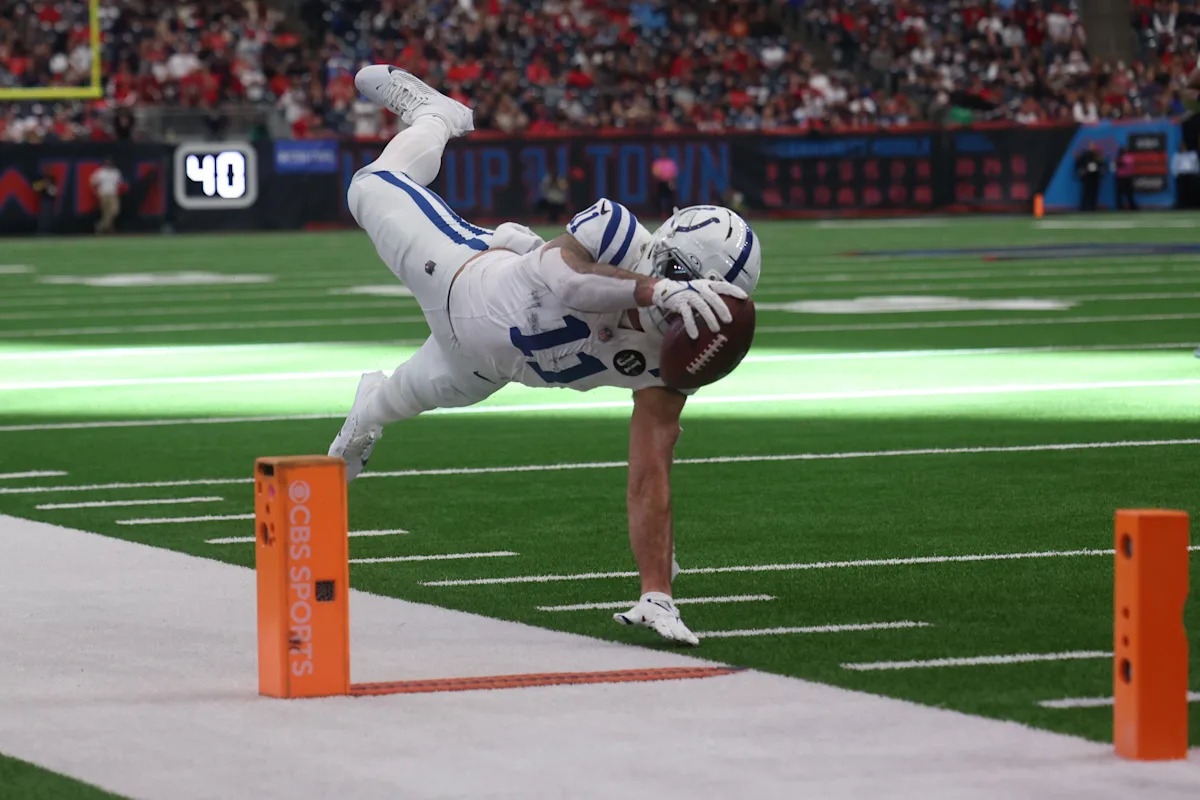
There’s a moment that every NFL franchise dreads but inevitably faces — the reckoning with player contracts that no longer sync perfectly with the team’s evolving needs and salary cap realities. For the Indianapolis Colts, that moment is now staring straight in the face with Michael Pittman Jr.’s contract looming large, carrying a costly $29 million cap hit for the upcoming year. Pittman, a once unequivocal No. 1 receiver who brought durability and professionalism to the field, finds himself at a crossroads as the Colt’s offensive landscape shifts. With critical financial commitments underway for quarterback Daniel Jones and young wideout Alec Pierce, the Colts must weigh their options carefully. Should they take the clean route and release Pittman to unlock vital cap space? Explore a trade that sounds ideal but falters under financial scrutiny? Or pursue a strategic extension that balances immediate relief with future potential? Each path holds its own set of consequences and signals a distinct vision for the franchise’s direction. It’s about more than just numbers; it’s about the Colts crafting a roster that’s both sustainable and competitive as they look ahead. The decision is complex, uncomfortable even, but clarity demands action — and this offseason, that action can’t be put off much longer.
A couple of months ago, I wrote that the Colts would eventually have to make a decision on Michael Pittman Jr.’s contract — a deal with one year remaining and a $29 million cap hit. That moment has arrived. While a release remains the cleanest and most likely path forward, it isn’t the only option on the table.
Cutting
The Michael Pittman Jr. conversation doesn’t exist in isolation anymore. It intersects directly with two looming commitments that will define the Colts’ offseason: long-term deals for Daniel Jones and Alec Pierce.
Advertisement
If those two contracts get done — and all signs point in that direction — the Colts are looking at roughly $50 million in cap commitments for 2026 between the quarterback and Pierce alone. That number doesn’t include extensions for other young players, depth signings, or injury buffers. It’s simply the cost of maintaining the offensive core.
When you view Pittman’s $29 million cap hit through that lens, the math changes quickly. Cutting or trading him clears approximately $24 million in space if done before the new league year, while absorbing about $5 million in dead cap. If the move is made after the league year begins, the Colts would eat roughly $7 million in dead money and save around $22 million. Either way, it’s a significant net gain in flexibility.
That isn’t marginal relief. That’s the lever that makes the rest of the offseason possible.
This isn’t about questioning Pittman as a player. He’s been durable, professional, and productive for much of his tenure. When he signed his extension, it made sense. He was the clear No. 1 receiver, the offense lacked established pass-catching depth, and stability mattered. But contracts are signed in one context and evaluated in another. The context has changed.
Advertisement
The Colts are not in cap hell, but their flexibility is thinner than it appears once future extensions are layered in. Quarterback uncertainty forced them to invest heavily in Jones. Pierce is entering his second-contract window and projects to command something in the neighborhood of four years and $80 million. That’s not optional spending — that’s foundational spending.
Trying to justify Pittman’s number on top of that becomes difficult, especially when the on-field hierarchy has shifted.
Over the final stretch of the season, Pittman totaled 26 catches for 212 yards and one touchdown across seven games — barely 30 yards per game on close to 40 targets. Meanwhile, Pierce emerged as the primary vertical stressor and Josh Downs continued to function as the most reliable chain mover. Pittman wasn’t absent from the offense, but he wasn’t tilting defenses either. At best, he operated as the third-most impactful receiver in the rotation.
In a pass-heavy offense built around volume, you can justify paying two receivers near the top of the market. In a system that prioritizes efficiency and spacing, that model becomes harder to sustain. Allocating premium money to two wideouts only works if both are consistently changing coverages. Right now, only one is.
Advertisement
Dead cap is the cost of correcting a contract that no longer aligns with roster construction. Eating $5–7 million to unlock more than $20 million in usable space is the type of trade-off teams make when they recalibrate. The Colts built an exit into this deal. Using it would not be reckless — it would be intentional.
That’s why cutting Pittman remains the cleanest solution. It creates immediate cap clarity, funds Pierce’s future, supports the quarterback investment, and avoids pushing money into future seasons. It doesn’t require creative accounting or borrowed time.
This decision will ultimately signal direction. Keeping Pittman suggests a belief that the current core is still ascending. Moving on — especially in conjunction with locking in Jones and Pierce — signals a recalibration toward younger, more vertically dynamic pieces.
None of this diminishes what Pittman has meant to the franchise. But roster building isn’t sentimental. It’s sequential. When you commit significant cap space to a quarterback and an ascending wide receiver, something has to give. The most logical and least complicated release valve is sitting right there in a $22–24 million cap savings.
Advertisement
And that’s why, as uncomfortable as it may be, cutting Michael Pittman Jr. remains the most likely outcome.
Trading
The idea of trading Michael Pittman Jr. sounds clean in theory. You get the same cap relief as a cut, you avoid turning an asset into nothing, and you recoup a pick. But once you walk through the actual mechanics, a trade quickly starts to fall apart.
The first issue is simple: Pittman’s contract number is out of alignment with his current market value. If his true value right now is in the $10–15 million per year range based on role and production, no team is lining up to absorb a $22–24 million cap hit for 2026. Even if a team likes him as a player, it’s hard to justify paying him like a top receiver when he’s no longer producing like one. That single gap between “what he’s worth” and “what he costs” is what kills most trade scenarios.
Advertisement
So you start thinking about the workaround: what if the Colts convert some of his base salary into a signing bonus to lower the incoming cap hit and make him more attractive to other teams? That’s where the math becomes a trap.
If Indianapolis has to restructure Pittman just to make him tradeable, then all they’ve really done is eat dead cap to help another team pay Pittman what he’s actually worth. The Colts would be sacrificing cap flexibility — the entire reason they’re considering moving on in the first place — just to maybe get a mid-round pick back. And at that point, you’re not really “trading Pittman” so much as you’re paying a portion of his contract for someone else to take him.
That’s the part that doesn’t add up. If you have to eat, say, $8–10 million in dead cap just to get his contract down into the $10–15 million range, you’re basically turning Pittman into the exact player the Colts would’ve been happy to pay in the first place — and then still losing him and possibly only getting a middle-round pick in return. It defeats the point.
And from the Colts’ perspective, there’s also a limit to how much you can push into signing bonus without making your own cap sheet worse. If you convert too much and create a big dead cap hit, you’re no longer creating the flexibility you need to sign Daniel Jones, extend Alec Pierce, and keep the roster stable. You’re just shifting the pain forward.
Advertisement
That’s why a trade is unlikely. The teams that would want Pittman won’t want him at $22–24 million. The Colts would have to pay down the contract to make it realistic. And if the Colts have to eat significant money just to get back a mid-round pick, they’re better off taking the clean exit: cutting him, saving the $24 million, and moving forward with full flexibility.
A trade is possible in the same way anything is possible in the NFL. But financially, it’s hard to find a scenario where it makes sense for both sides.
Extending
If cutting Pittman is the cleanest option, extending him is the most practical one.
Advertisement
Right now, Pittman is scheduled to carry a $29 million cap hit in 2026 — built off a $22 million base salary, $5 million in signing bonus proration, and a $2 million roster bonus. That number is difficult to justify in isolation. But it’s also flexible.
A two-year extension worth roughly $20 million in new money could dramatically change the picture.
Here’s how it works.
The Colts would keep the existing $5 million signing bonus proration and the $2 million roster bonus intact. They would then convert roughly $20 million of Pittman’s 2026 base salary into a signing bonus. That bonus would prorate over the remaining three years of the deal, adding about $6.66 million per season.
Advertisement
Under that structure, Pittman’s cap hit drops from $29 million to roughly $15.66 million in 2026. In 2027 and 2028, his cap number would sit around $16.66 million annually, assuming modest base salaries (around $2 million) and manageable roster bonuses.
From the Colts’ perspective, that’s nearly $14 million in immediate cap relief while still maintaining control of the player for up to two additional seasons.
From Pittman’s perspective, it’s not a loss. He effectively turns his current situation into a three-year deal worth around $48–49 million. He secures $20 million in new money on top of what he was already set to earn in 2026, stays in the same system, and protects himself against being outright released.
And there’s still flexibility.
Advertisement
If the Colts decide after 2026 that it’s time to move on, they could structure the deal to allow a release that saves roughly $10 million in 2027. Pittman would still have collected around $24 million for 2026 alone, meaning he doesn’t walk away empty-handed. If he performs well, he remains under contract at cap numbers that are far more in line with his current market value. If he doesn’t, the Colts aren’t stuck.
That’s what makes this option intriguing.
It doesn’t commit the franchise long-term in an inflexible way. It reduces the 2026 cap hit enough to help fund extensions for Daniel Jones and Alec Pierce. And it avoids turning a respected veteran into a dead cap casualty.
The downside, of course, is philosophical. You’re still allocating meaningful cap space to a receiver whose role has diminished within the offense. You’re betting on a rebound rather than a reset. And you’re pushing some money into future seasons instead of wiping the slate clean.
Advertisement
But compared to the trade scenario — which likely requires Indianapolis to eat money just to receive a mid-round pick — an extension at least creates mutual benefit. It aligns Pittman’s compensation closer to his current value, creates immediate savings, and preserves optionality.
In other words, if the Colts aren’t ready to fully detach, restructuring and extending him becomes the middle ground.
It’s not as decisive as a cut. It’s not as clean as starting over. But financially, it might be the compromise that keeps the books balanced while buying the front office another year to evaluate the direction of the offense.
In a vacuum, the extension might be the most balanced solution. It lowers the cap hit, keeps a respected veteran in the building, and preserves flexibility beyond 2026. It’s the compromise option — not as drastic as a cut, not as unrealistic as a trade — and it allows the Colts to recalibrate without fully detaching from a player who has meant a great deal to the franchise.
Advertisement
But balance doesn’t always win in the NFL. Clean cap sheets usually do.
When you factor in the looming commitments to Daniel Jones and Alec Pierce, the shifting hierarchy within the offense, and the simple math of $22–24 million in immediate savings, cutting Michael Pittman Jr. remains the most probable outcome. It’s the most direct path to financial clarity and roster flexibility.
The extension may be the most reasonable scenario on paper. The cut is the one that aligns most clearly with how front offices operate when hard decisions have to be made.
And this offseason, the Colts are staring at one.

![Unlock the Shocking Secret Behind [Article Topic] That Everyone Missed!](https://gameonbrain.com/wp-content/uploads/2026/02/unlock-the-shocking-secret-behind-article-topic-that-everyone-missed.jpg)
Post Comment