





Racism in Football: The Controversial Case for Lifetime Bans That Demands Uncovering the Truth First
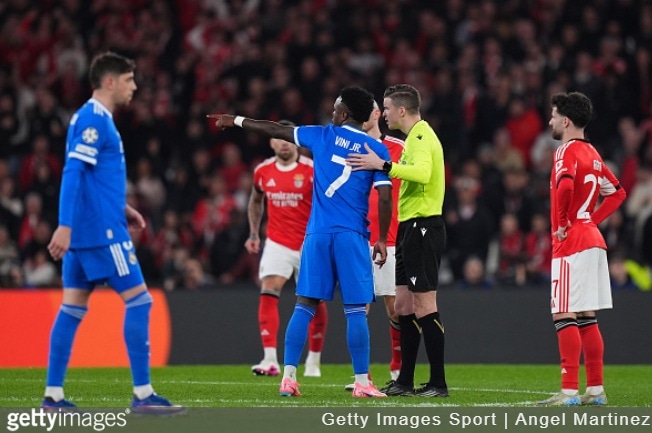
February 17, 2026—a night in Lisbon that was supposed to be all about football magic, passion, and the relentless tug of Champions League dreams. Instead, Real Madrid’s visit to Estadio da Luz quickly spiraled into something nobody wanted: a disturbing allegation of racism that paused the game for nearly ten minutes and sent ripples far beyond the pitch. Vinícius Júnior, the blazing forward whose goal should have been the star moment, became the center of an unsettling controversy after accusing Benfica’s Gianluca Prestianni of a racial slur. The incident didn’t just interrupt the match; it dragged the sport’s ongoing battle with racism to the forefront once again, igniting fierce debates, intense emotions, and an urgent call for decisive action. This isn’t just a story about a game—it’s about the values football claims to hold and the deep wounds still left unhealed in its wake. LEARN MORE
When Real Madrid walked into Lisbon’s Estadio da Luz on February 17, 2026, they expected a fiercely contested Champions League playoff match. What they did not expect was that the football itself would soon be overshadowed by a racism allegation that halted the match for nearly ten minutes and sent shockwaves throughout the sport.
Real Madrid forward Vinícius Júnior, who scored the match’s decisive goal early in the second half, accused Benfica’s Gianluca Prestianni of directing a racist slur at him. The allegation immediately triggered UEFA’s anti-racism protocol on the field and set off an investigation that is now being closely watched across the global football community.
In the minutes following Vinícius’ brilliant finish, the scenes shifted from celebration to chaos. Objects rained down from the stands as Benfica supporters reacted angrily to the forward’s dancing celebration by the corner flag. Cameras captured Prestianni confronting Vinícius with his mouth covered by his shirt—an image that, in the heat of the moment, seemed to carry heavy implications. Vinícius alleged that the Argentine winger called him “monkey,” prompting the Brazil international to approach referee François Letexier, who immediately halted the match and initiated FIFA’s protocol for dealing with racist incidents.
As the stadium fell into a tense silence, players debated whether to leave the pitch altogether. Some, including Kylian Mbappé and Aurélien Tchouaméni, reportedly urged Vinícius to decide whether the team should continue. The match resumed only after nearly ten minutes of emotional turmoil. Real Madrid’s eventual 1–0 victory became almost an afterthought.
After the match, Vinícius posted a message declaring, “Racists are, above all, cowards,” emphasizing how the incident was “nothing new” in his life. His reaction resonated with many who have followed his years-long struggle against racism in stadiums across Spain.
But as is always the case in these situations, the allegation did not stand unchallenged. Prestianni denied the accusation, insisting he had “never been racist with anyone,” and Benfica quickly declared the player a victim of a “defamation campaign.” The club publicly welcomed UEFA’s investigation and stated it fully supported Prestianni’s version of events.
Real Madrid, for their part, submitted “all available evidence” to UEFA and expressed appreciation for the global wave of support for Vinícius. UEFA and FIFA leadership, including President Gianni Infantino, condemned the incident and reinforced calls to eradicate racism from the sport once and for all.
What unfolded that night in Lisbon represents yet another chapter in an all-too-familiar story. Football, a sport built on passion, identity, and unity across borders, continues to grapple with racism at every level—from fans in the stands to players on the pitch. And this story is far from unique. Yet each incident carries its own human weight, fracturing trust, corroding the spirit of the game, and causing pain that extends far beyond ninety minutes.
So what should the football world do?
Not what it has done so far. Not the tepid fines, the closed-door matches, the symbolic warnings. If a player is proven to have used racist language or actions, the punishment must be swift, severe, and unequivocal: a lifetime ban from the sport.
This is not about vengeance or overreach—it’s about protecting the integrity of the game and the dignity of every person who steps onto the pitch. Football cannot thrive if racism is allowed to linger in its bloodstream.
However, and critically: the emphasis must be on “proven.”
The rush to judgment can be immensely damaging—both to victims of racism and to players falsely accused. Allegations of this gravity require rigorous, transparent, and unbiased investigations. Technology (including high-fidelity audio capture), witness statements, forensic analysis of match footage, and multilingual expert review must all play a role in determining the truth.
The incident in Lisbon illustrates this need perfectly. The confrontation happened in the heat of a goal celebration, with emotions running high and communication obscured—literally, in this case, as Prestianni’s mouth was covered. Benfica argues that witnesses were too far away to corroborate Vinícius’ account. Real Madrid insists they have submitted strong evidence. Both sides deserve a fair process.
Immediate assumptions—by fans, pundits, or even officials—risk distorting justice. A lifetime ban is one of the most severe punishments imaginable in professional sports. Applying such a penalty requires absolute certainty.
Some critics argue that the threat of lifetime bans could encourage false allegations. But this fear should not weaken the fight against racism; instead, it should reinforce the necessity of meticulous, high-standard investigations. Racism in football is a crisis that demands bold solutions, not hesitation.
At the same time, football must acknowledge its failures. Protocols, though essential, often feel performative, especially when victims perceive that little changes afterward. Vinícius himself called the protocol “poorly executed” and meaningless. His frustration reflects a broader crisis of trust. For protocols to matter, consequences must follow.
If UEFA’s investigation confirms that Prestianni used racist language, then the path forward must be uncompromising. A slap on the wrist is not enough. Neither is a suspension of a few matches. Those who engage in racism should not be given second chances in the world’s most beloved sport.
But if the investigation finds insufficient evidence—or proves he is innocent—then Prestianni deserves public exoneration, and the football community must treat him fairly and responsibly. Racism is abhorrent, but unjustly labeling someone a racist carries its own harm, heavy and lasting.
Ideally, the process should be concluded before the rematch in Madrid takes place next week, but it would be obviously unrealistic to expect that to happen.
Ultimately, the Lisbon incident serves as both a warning and a call to action. Football stands at a crossroads. The sport must decide whether it will continue letting racism flare up episodically, or whether it is finally ready to cleanse itself of this poison with measures that match the seriousness of the offense.
The message needs to be clear:
If you are accused of racism in football, you deserve a full and fair investigation.
If found guilty beyond reasonable doubt, you should never be allowed to play professionally again.
These two principles are not in conflict; in fact, they depend on each other. Strong justice demands strong truth.
The events of February 17—charged, emotional, painful—should be a turning point. Not another headline, not another debate, not another fleeting controversy, but the spark that pushes football toward a zero-tolerance era defined by both moral courage and procedural fairness.
Only then can the game truly live up to the values it so often claims to champion.


Post Comment