








Can UConn and the Top Seeds Keep March Madness from Turning into an Upset Frenzy?
We’ve simulated the NCAA women’s basketball tournament thousands of times to find the chances of teams advancing throughout March Madness. UConn seeks to go back-to-back.
Surely, someone is going to party at the NCAA Division I women’s basketball Final Four like it’s … 2025?
The first weekend of April in Phoenix could wind up looking familiar to last yearâs Final Four, which consisted of all four of this yearâs No. 1 seeds.
UCLA, Texas and South Carolina also were 1-seeds a year ago, and UConn was a 2-seed while it captured its record 12th national title.
March Madness is synonymous with surprises, of course, but those four teams have played much of this season as if the 68-team bracket should just skip to the Final Four â to let them battle it out.
In TRACR (Team Rating Adjusted for Conference and Roster), our net efficiency metric that calculates a teamâs points per possession on both sides of the ball, adjusted for the strength of the opponent, UConn has been No. 1 the entire season. UCLA is right behind at No. 2 and hasnât been below 4. Then itâs No. 3 Texas and No. 4 South Carolina, and each has only briefly fallen to 5, with LSU making a few appearances in the top four.
Not surprisingly, the four No. 1 seeds top the championship probabilities following our thousands of March Madness simulations run through the Opta supercomputer.
Four of the previous 43 NCAA tournaments ended with all four No. 1 seeds at the Final Four: 1989, 2012, 2015 and 2018. This year, UCLA and Texas gain an advantage of not having to leave their states through the Elite Eight.
Fort Worth 1 Regional
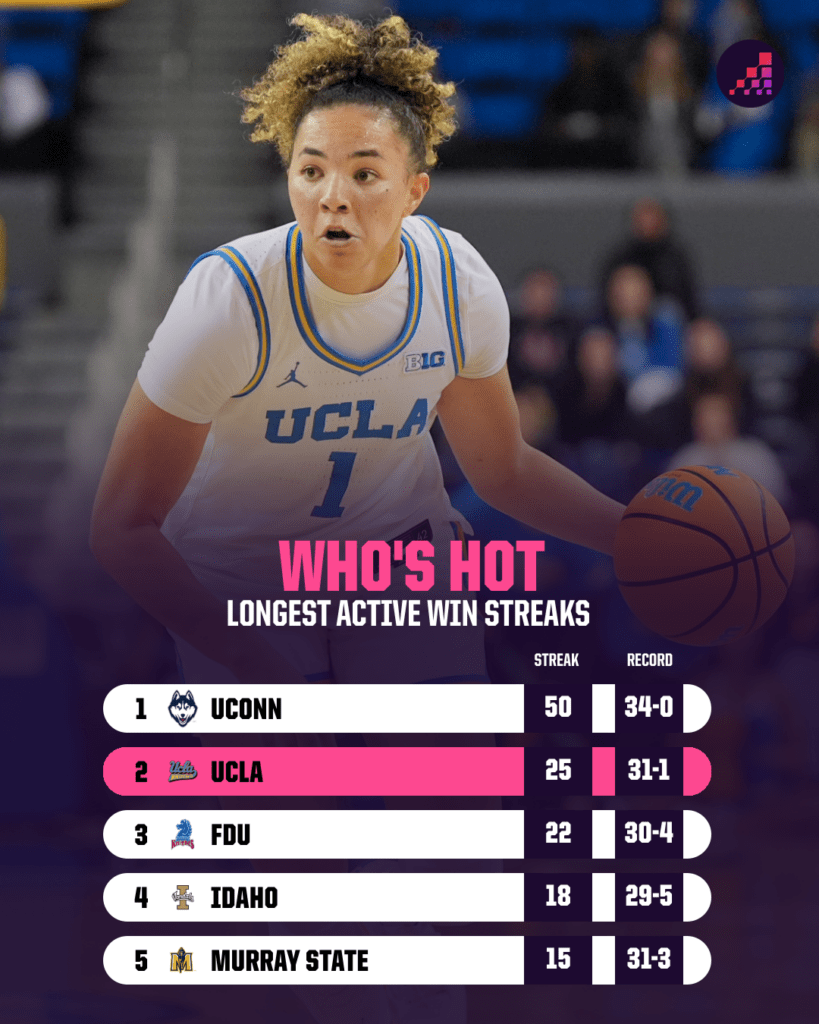
UConn (34-0) is seeking to become the first repeat champion since the dynasty programâs 2013-16 squads won four titles in a row. Dating to last season, the Huskies have won 50 straight games for the fifth-longest streak in D-I history (the top three runs also are under coach Geno Auriemma).
On a team that leads the nation in field goal percentage both offensively and defensively, power forward Sarah Strong is No. 1 overall in DRIP, and ranks third with shooting guard Azzi Fudd fourth in WAR. Only Tennessee and Villanova have held a second-half lead against UConn, and only Michigan (72-69) has finished within single digits of the Big East champ while it’s posted a national-high average scoring margin of plus-38.4.
Interestingly, UConnâs regional includes D-Iâs top four in individual scoring average: Vanderbiltâs Mikayla Blakes (27.0), Iowa Stateâs Audi Crooks (25.5), Notre Dameâs Hannah Hidalgo (25.2) and Western Illinoisâ Mia Nicastro (24.2). Also, Murray Stateâs Sharnecce Currie-Jelks is No. 1 in double-doubles (26).
Probability of Making Sweet 16, Final Four
- 1. UConn: 93.8% Sweet 16, 74.6% Final Four
- 2. Vanderbilt: 69.1%, 7.1%
- 3. Ohio State: 64.9%, 7.9%
- 4. North Carolina: 41.8%, 2.1%
- 5. Maryland: 55.1%, 4.5%
- 6. Notre Dame: 31.5%, 2.1%
- 7. Illinois: 21.6%, 0.8%
- 8. Iowa State: 4.3%, 0.6%
- 9. Syracuse: 1.73%, <0.1%
- 10. Colorado: 9.1%, <0.1%
- 11. Fairfield: 3.5%, 0.1%
- 12. Murray State: 2.0%, <0.1%
- 13. Western Illinois: 1.1%, <0.1%
- 14. Howard: 1.7%, <0.1%
- 15. High Point: 2.3%, <0.1%
- 16. UTSA: 0.1%, <0.1%

Sacramento 2 Regional
Nobody had carved Thanksgiving turkey yet when UCLA (31-1) suffered its only loss to Texas, and the Big Ten champ has gone on to collect 19 Quad-1 wins, the most nationally and more than double UConnâs nine. The Bruins, though, havenât won a national title since 1978 in an AIAW Tournament that was a precursor to the womenâs NCAA Tournament.
Coach Cori Closeâs squad is built around 6-foot-7 senior center Lauren Betts, who helps define the team dynamic. Ranked No. 1 in offensive TRACR, UCLA has gained 89.6% of its points from seniors, and the nine players who have averaged at least 10 minutes per game stand over 6-2 on average.
LSU (27-5) is a potential party crasher to the Final Four, leading D-I with 94.5 points per game and boasting extensive NCAA Tournament experience with guards Flau-jae Johnson, Mikaylah Johnson and MiLaysia Fulwiley, a transfer from South Carolina. The Tigers have wins over Texas and Duke, the regionâs No. 3 seed but eighth in TRACR.
Probability of Making Sweet 16, Final Four
- 1. UCLA: 89.3% Sweet 16, 46.5% Final Four
- 2. LSU: 89.0%, 41.5%
- 3. Duke: 62.5%, 5.9%
- 4. Minnesota: 60.3%, 2.9%
- 5. Ole Miss: 33.9%, 1.3%
- 6. Baylor: 18.8%, 0.4%
- 7. Texas Tech: 6.1%, 0.3%
- 8. Oklahoma State: 8.4%, 0.6%
- 9. Princeton: 1.9%, <0.1%
- 10. Villanova: 4.8%, 0.2%
- *11. Nebraska: 15.3%, 0.5%
- *11. Richmond: 2.2%, <0.1%
- 12. Gonzaga: 4.2%, <0.1%
- 13. Green Bay: 1.5%, <0.1%
- 14. Charleston: 1.2%, <0.1%
- 15. Jacksonville: 0.2%, <0.1%
- 16. Cal Baptist: 0.4%, <0.1%
*-Will meet in First Four
Fort Worth 3 Regional
Texas (31-3), seeking its first national title in 40 years, boasts a No. 2 ranking in defensive TRACR â that end of the floor is a staple for Vic Schaefer-coached teams â while junior forward Madison Booker is No. 2 in WAR behind only Notre Dameâs Hannah Hidalgo. The Longhorns also are quite battle-tested coming out of the Southeastern Conference, with its 14 overall Quad-1 wins including two over South Carolina.
However, the NCAA Tournamentâs three other No. 1 seeds are top eight of D-I field goal percentage, while the Longhorns are just 63rd. Plus, the Longhorns’ 4.3 made 3s per game rank a mere 323rd, which could factor in heavily to a regional that has the most top-15 teams in TRACR (also Michigan, Louisville, West Virginia and Kentucky).
Tennessee (16-13) gained an at-large bid despite having seven straight losses. Itâs the only program to make an appearance in every NCAA tourney (44).
Probability of Making Sweet 16, Final Four
- 1. Texas: 88.6% Sweet 16, 55.8% Final Four
- 2. Michigan: 72.7%, 21.1%
- 3. Louisville: 71.3%, 11.4%
- 4. West Virginia: 53.2%, 4.8%
- 5. Kentucky: 38.1%, 3.8%
- 6. Alabama: 22.9%, 1.2%
- 7. NC State: 12.9%, 1.2%
- 8. Oregon: 7.6%, 1.2%
- 9. Virginia Tech: 3.6%, 0.2%
- 10. Tennessee: 14.0%, 1.8%
- 11. Rhode Island: 4.3%, 0.1%
- 12. James Madison: 6.6%, 1.1%
- 13. Miami (OH): 2.1%, <0.1%
- 14. Vermont: 1.5%, <0.1%
- 15. Holy Cross: 0.3%, <0.1%
- *16. Missouri State: 0.1%, <0.1%
- *16. Stephen F. Austin: <0.1%, <0.1%
*-Will meet in First Four

Sacramento 4 Regional
South Carolina (31-3), last yearâs national runner-up and a three-time champion under coach Dawn Staley since 2017, is a No. 1 seed for the sixth consecutive year. Unlike the top-heavy nature of Texasâ regional, the Gamecocks may have the easiest path to the Final Four. Theyâre No. 4 in TRACR, and the next-highest rankings are TCU (10) and Iowa (14).
South Carolina is tied for the national high with five starters scoring in double figures (minimum 15 games), led by All-America forward Joyce Edwards (19.6)
Oklahoma, also from the SEC, is another of the teams with five players averaging in double figures, led by guard Aaliyah Chavez (18.4), with the Sooners one of only six Division I teams to have the same starting lineup all season (FDU and Oklahoma State also among NCAA Tournament qualifiers). Additionally, TCU has guard Olivia Miles and her five triple-doubles (only one other D-I player has two), while Iowa seeks to improve on its second-round exit last March in this year’s second season after Caitlin Clark.
Probability of Making Sweet 16, Final Four
- 1. South Carolina: 89.6% Sweet 16, 55.8% Final Four
- 2. Iowa: 66.2%, 11.6%
- 3. TCU: 64.0%, 10.1%
- 4. Oklahoma: 59.7%, 12.2%
- 5. Michigan State: 37.9%, 4.7%
- 6. Washington: 26.9%, 2.2%
- 7. Georgia: 20.7%, 1.5%
- 8. Clemson: 2.1%, 0.1%
- 9. USC: 8.3%, 0.7%
- *10. Virginia: 8.7%, 0.6%
- *10. Arizona State: 3.3%, <0.1%
- 11. South Dakota State: 8.2%, 0.4%
- 12. Colorado State: 1.8%, <0.1%
- 13. Idaho: 0.7%, <0.1%
- 14. UC San Diego: 0.9%, <0.1%
- 15. FDU: 1.1%, <0.1%
- **16. Southern: <0.1%, <0.1%
- **16. Samford: <0.1%, <0.1%
* and **-Will meet in First Four
Data modeling by Matt Scott. For more coverage, follow on social media at Instagram, Bluesky, Facebook and X.
The post Women’s NCAA Tournament Predictions: UConn, No. 1 Seeds Aim to Prevent the (March) Madness appeared first on Opta Analyst.















Post Comment