








Could a Four-Point Field Goal Revolutionize the NFL’s Spring League and Change the Game Forever?
Place-kickers have become so proficient that the number of field goals attempts and makes from 60 or more yards are rising at notable rates. The NFL style of play would change if it started rewarding mega-kicks with four points, instead of three, like the UFL this spring.
Brandon Aubrey made one of the great plays of the 2025 NFL season last September.
In Week 2, the Dallas Cowboys trailed by three points when its offense moved the ball to the New York Giants 46-yard line with five seconds remaining. One play earlier, coach Brian Schottenheimer was so confident in Aubrey â the teamâs place-kicker â that the Cowboys ran the ball with nine seconds left, gaining 3 yards as if they were just trying to set up Aubrey for a chip shot.
It may as well have been that when Aubrey blasted a 64-yard field goal through the uprights to send the game to overtime. The 46-yarder he later hit to win it as time expired in OT must have felt like childâs play as the Cowboys prevailed 40-37.
As recently as 2023, Aubrey was kicking for the Birmingham Stallions in the UFL, a spring league. While heâs gone on to NFL stardom, it would be fun to watch him kick in the UFL today because the league is unveiling a new rule in its 2026 season, which begins on March 27, that increases a field goal made of 60 yards or longer from the standard three points to four.
The UFL is pairing it with a rule that prevents an offense from punting once it crosses midfield into an opponentâs side except in the final two minutes of either half.
The idea was clear enough: Create drama by making teams go for fourth downs or, failing that, attempt titanic field goals. UFL head of officiating Dean Blandino has argued â60-yard field goals are the new 50-yard field goals.â
Although such opinion is reasonable, Blandino may be pushing it a bit. The 2025 NFL season brought a record 12 makes and 22 attempts from 60-plus yards, including the Jacksonville Jaguarsâ Cam Little kicking a 68-yarder for the NFL all-time high. In no year this century has the NFL had fewer than 68 attempts from 50+ (the low water mark was in 2000). But 60-yard tries have roughly quadrupled over the past decade, and it feels inevitable the number will keep going up unless the league intervenes to make a kickerâs job harder.
But the UFL presents an alternative question to Roger Goodell and the NFL competition committee: What if the NFL not only avoided making kickersâ jobs harder but rewarded them even more for their mega-legs?
Notably, the NFL has already adopted a kicking rule from spring league football. The dynamic kickoff rule, which places coverage players and blockers close together to decrease high-speed collision and its risk of injury, originated in the XFL and continued into the UFL, with the NFL experimenting with it in 2024 and adopting for the 2025 season.
Elite Kickers Fuel Rise in 60-Yard FGs
The long-range kicking scenario has changed dramatically in recent years. In five different NFL seasons from 1989 to 2002, there wasnât even a 60+ yard field goal attempt. But thereâs been at least one in every season since 2003, and a kicker has made one in each of the past 11 seasons since 2015. The five-year rolling average of 60+ yard attempts did not crack 3.0 until 2017 or 6.0 until 2023. But it stands at 13.6 entering the 2026 season after the leagueâs kickers went nuts in 2025.
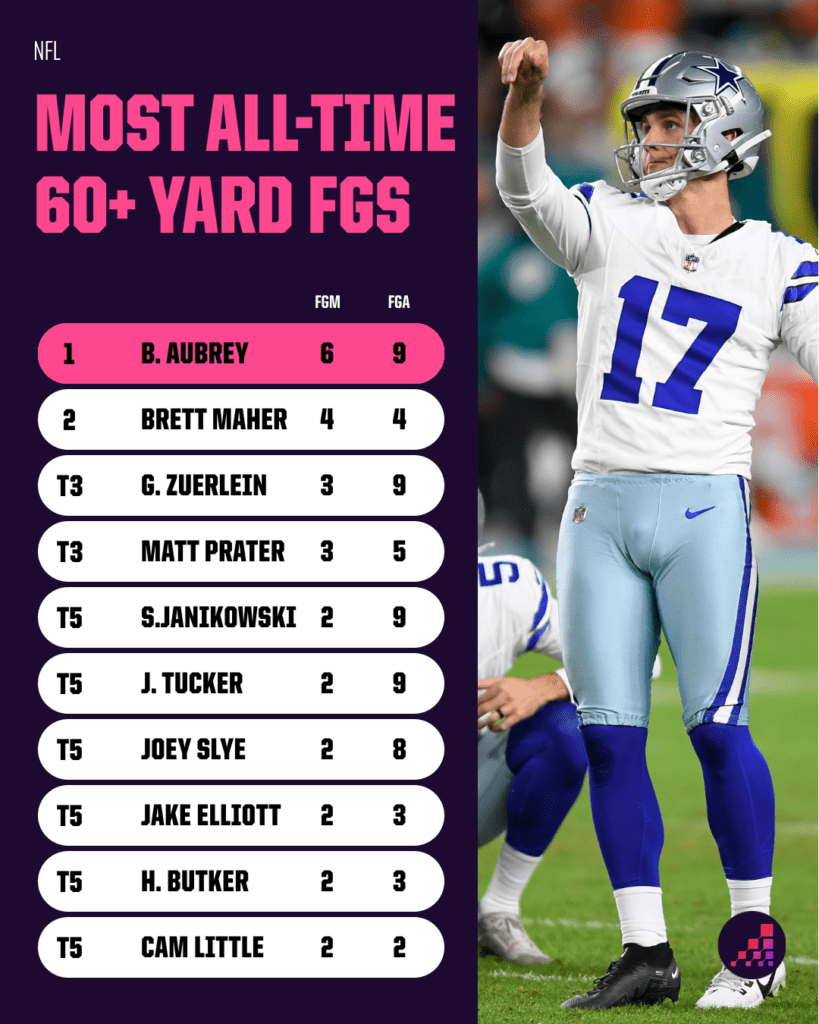
Actually, âthe leagueâs kickersâ is a bit of a misnomer. The league is 38 for 98 from 60+ in the past 10 seasons, but a small handful of kickers have done most of that work on their own.
Aubrey leads with six makes followed by Brett Maher with four. Only eight other kickers in league history have even made at least two. Isnât that the best argument for the NFL dabbling in four-point field goals?
At its best, football should encourage its most special players to make special plays, and it should punish them when they try and fail.
A four-point 60-yard field goal scratches both of these itches: The kicking team either gets a point total thatâs 33% higher than a typical field goal or it surrenders the ball at midfield or worse.
All of which is to say: Itâs cool the UFL is trying to modernize the game, but the league that would be most fascinating to see four-point field goals is the NFL, which has the worldâs best kickers.
In the UFL, using four-point field goals is a fun experiment at best, a gimmick at worst. In the NFL, it would be a legitimate competitive weapon.
Effects of Four-Point Field Goals
Four-point field goals would shift the NFLâs competitive math in a few ways:
1. Youâd see more attempts that kickers might actually miss. Exactly how many? We donât know.
But consider how boring most NFL field goals have gotten as the league has improved across the board. Last season, NFL kickers made 95.1% (484 of 509) of their kicks from inside 40 yards as well as 84.3% (264 of 313) from 40 to 49 yards. Thereâs still a bit of drama here â hello, Tyler Loop and his 44-yard attempt that misfired on the final play of the regular season, costing the Baltimore Ravens a playoff spot â but itâs less than ever before. NFL kickers âonlyâ clicked at 54.5% from 60+ last year, though.
If you want to watch kicks that are truly something close to a coin flip, the options are to make kicking harder â say, manipulate the footballs or tighten the uprights â or make kicking harder field goals more valuable. The latter introduces field position risk, which makes it more fun.
2. Late-game decision trees would be thrown into chaos. Consider the Aubrey bomb that forced overtime against the Giants last season. If the teams had known such a kick would be worth four points, not three, how would the end of the game have played out?
For one thing, when the Giants went ahead with 25 seconds left on a Malik Nabers touchdown catch, would they have considered going for a two-point conversion (another fun tossup play) so that Aubrey couldnât beat them with the four points of a 60-yarder? Imagine how much more fun that wouldâve been than Graham Gano kicking an extra point.
And what about the Cowboys? Consider their situation with nine seconds left at the Giants 49. A gain of more than 7 yards would have taken Aubreyâs attempt out of four-point range and down to 59 yards and three points. Would that have encouraged the Giants defense to defend a more shallow area of the field, assuming Dallas wouldnât attempt another deep pass to George Pickens? If so, would quarterback Dak Prescott have done just that? The theory of the game would shift.
In rare cases, those shifts would be downright funky. Would a team facing fourth down at the opponent’s 39 back up 3 yards to turn a 57-yard field goal attempt into a 60-yarder? Perhaps so.
But what a risk that would be for a coach to take â the media would not be kind to him if his kicker then narrowly missed the four-point try.
3. There would be less plus-field punting and thus a lot fewer offensive drives starting inside the 10.
Last year, NFL teams punted 249 times from between an opponentâs 42 and midfield (the range of a 60- to 68-yard field goal). About 37% of those punts resulted in the opposing offense taking over inside its 10.
How many teams would have gone for a field goal instead if they had a kicker they believed in and could steal a fourth point by making it? How many attempts would they miss, creating a short field for the opponent? If you enjoy both lots of points and risk/reward calculations, four-point field goals from 60+ yards encourage both.
CAM LITTLE SETS THE NEW NFL RECORD FOR LONGEST FIELD GOAL

Related Posts

Hot Takes












Post Comment