



Inside the Secret Strategies That Make Divisional Playoff QBs Unstoppable—And Completely Unique
BUFvsJAX on CBS/Paramount+
Stream on @NFLPlus pic.twitter.com/lt9NbExrlx
— NFL (@NFL) January 11, 2026
Allen posted a perfect 100% well-thrown rate in the fourth quarter against the Jaguars and did not throw a single pickable pass on those 11 attempts. He was the only QB with at least five fourth-quarter attempts to accomplish that last weekend.
During the regular season, he led the NFL in passing plays of 25 yards or more and ranked fourth in completion percentage and yards per attempt in the fourth quarter of seven-point games.
Some of this comes from pure talent, but Allen is also playoff-tested. This game was his 14th career postseason appearance, which is the most among the winning quarterbacks from the wild-card round.
Caleb Williams, Chicago Bears: Explosive Plays
Williams has been a polarizing quarterback throughout his young career, and that narrative continued in his first career playoff game.
He had the lowest completion rate and catchable-ball rate (CTBL) among all 12 quarterbacks in the wild-card round at 52.2% and 56.5%, respectively. These numbers didn’t improve in the fourth quarter when he completed just 50% of his passes with a 55.0% CTBL rate.
But, as Williams has done all season long, he excelled on big plays that moved the Bears into scoring position in the fourth quarter. On his game-winning drive, Williams completed passes of 12, 23 and 25 â the last being the touchdown to Moore with 1:48 left in the game.
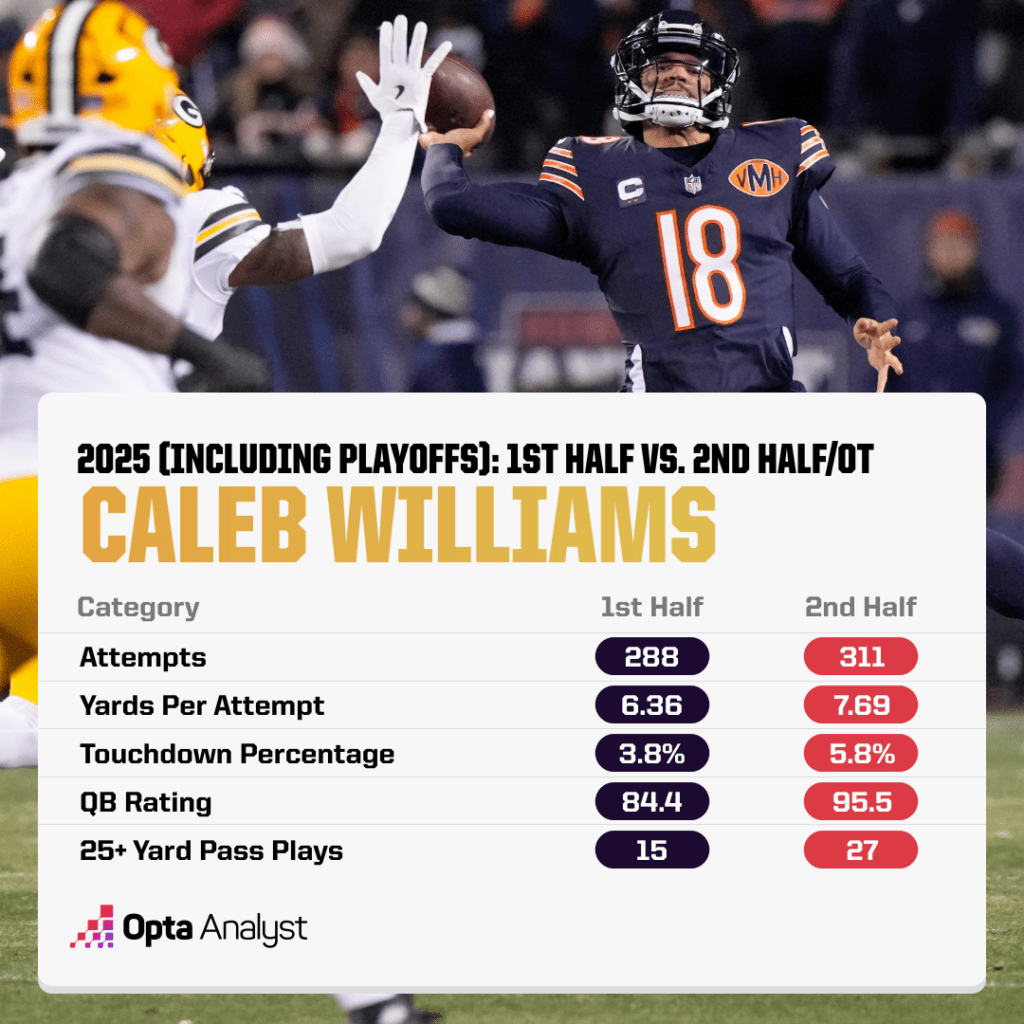
Including the playoffs, Williams has a league-best 27 pass plays of at least 25 yards in the second half. Matthew Stafford of the Los Angeles Rams, Chicago’s next opponent, is second with 24 such plays.
This has been a trend for the Bears this year. Chicago ranks 11th in the NFL with a 9.3% explosive pass play rate in quarters one through three (including the wild-card round), but that number jumps to a league-best 14.4% in the fourth quarter.
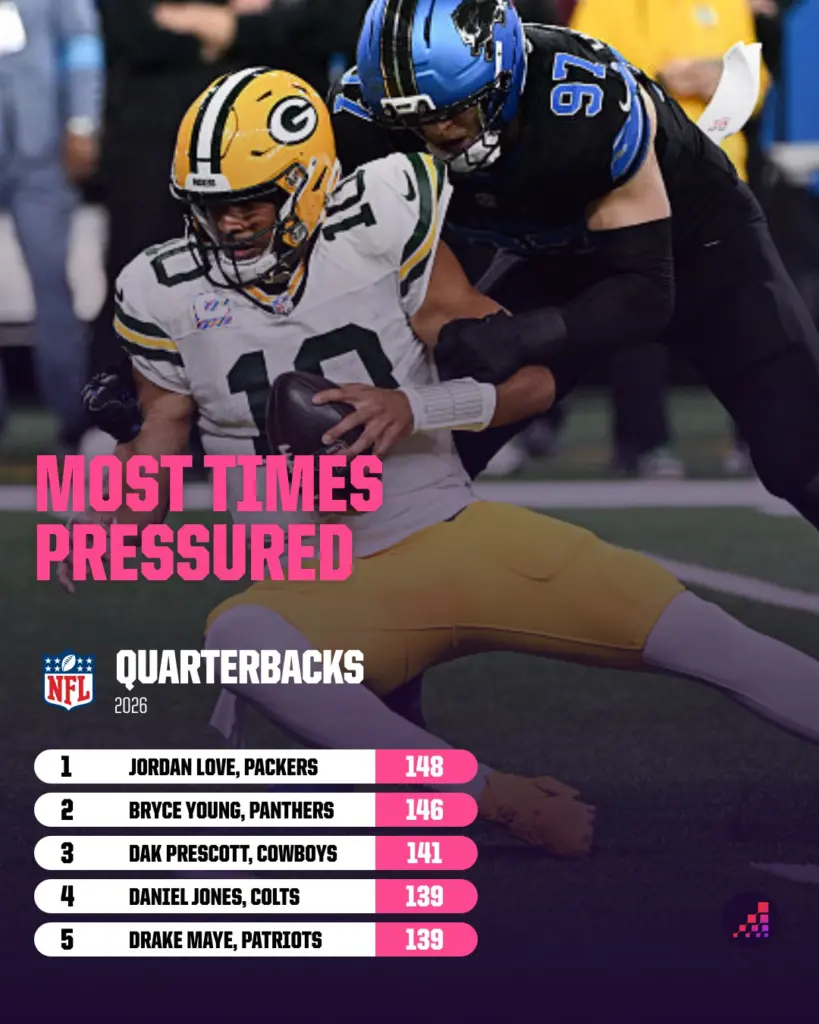
Some of this can be attributed to Ben Johnsonâs play-calling, but Williams also knows how to extend plays with his legs. The Bears allowed the highest pressure rate in the wild-card round and the third-highest pressure rate in the fourth quarter, yet Williams finished with the lowest sacks per drop-back rate and sacks per pressure rate both over the entire game and exclusively in the fourth quarter.
Brock Purdy, San Francisco 49ers: Methodical Drives
Purdy overcame arguably the roughest playoff performance of his career to pull off a comeback win over the vaunted Eagles defense. And he didnât do it by being more accurate or more explosive.
Purdy did it by sticking with the game plan and moving down the field methodically. He only had two true offensive drives in the fourth quarter: One ended in his second interception, and the other ended in the game-winning touchdown.
Purdy pulled off the comeback by chipping away at the Eagles defense until the 49ers were in scoring position. His average air yards in the fourth quarter was 6.75, which ranked last among the wild-card round quarterbacks. Purdyâs longest passing attempt was 16 yards downfield to receiver DeMarcus Robinson.
San Francisco head coach Kyle Shanahan didnât need to rely on explosive plays to win the drive. His teamâs 5.9% explosive play rate in the fourth quarter ranked sixth among the 12 playoff teams, but fifth among the six teams that won. This isnât a knock on Purdyâs playmaking ability as much as it is just trust in the quarterback and the offensive scheme.
Considering Shanahan and Purdy are headed to their third divisional round in four seasons, itâs clearly working.
Matthew Stafford, Los Angeles Rams: Offensive Execution
Stafford is the most veteran quarterback of this group. Heâs played in just 10 postseason games but has 17 full seasons of experience under his belt.
So it makes sense how he orchestrated the Ramsâ game-winning drive at the end of their 34-31 win: He just executed the offense.
Stafford finished the fourth quarter with an 80.0% in-design rate, meaning the majority of his passing attempts unfolded within the designed play instead of more out-of-structure situations.
That led to the best fourth-quarter offensive success rate among the playoff teams as well.

He completed 6 of 7 passes for 71 yards on the final drive of the game and 12 of 18 overall in the fourth quarter for 143 yards and two touchdowns with just one pickable pass. Stafford also had the second-fastest release time in the fourth quarter among all 12 quarterbacks.
Head coach Sean McVay has perfected the offense under Stafford, which is partly why the team ranked No. 1 in offensive success rate scoring this year. That faith bore out in the final drive of the game to stave off a valiant upset bid by the Carolina Panthers.
The True Definition of Clutch
The wild-card round made one thing clear: there is no single blueprint for being clutch. The only part that really matters is winning.
When the margins are thin, the clock is running out and teams need points, style points donât matter. All four QBs showed the ability to shine in the clutch in completely different ways.
For more coverage, follow along on social media on Instagram, Bluesky, Facebook and X.
The post How the Most Clutch QBs of the Divisional Playoffs Are Doing It in Completely Different Ways appeared first on Opta Analyst.








Post Comment